
Table of Contents
- Start With Your Measurements, Not the Size Tag
- How to Style Clothes for Curves: Balance Fitted and Loose Pieces
- The Best Pants for a Curvy Figure: Waistbands, Rises, and Fabrics
- Dresses for Curvy Body Types: Hemlines, Fabrics, and Silhouettes
- Curvy Wardrobe Essentials That Mix and Match
- Fit Troubleshooting: When to Tailor and What to Avoid
- Frequently Asked Questions
Last Updated: October 7, 2026
Start With Your Measurements, Not the Size Tag
Size tags lie. A 1X from one label can fit like a 2X from another, and that gap is the biggest reason curvy shoppers end up with a closet full of returns.
At Jones & Ivy Collections, Inc, we hear the same frustration weekly: customers know their size but do not trust it. Our advice is simple, ignore the label and let your own numbers pick the garment.
How to Measure Your Waist, Hips, and Inseam at Home
Waist measurement is the smallest point of your torso, usually just above the belly button.
Hip measurement is the fullest part of your seat and hips, feet together. Keep the tape level all the way around.
Inseam runs from the crotch seam to the hem of pants that already fit well.
A few ground rules:
- Wear thin clothing or measure over your undergarments
- Keep the tape parallel to the floor
- Write the numbers down in inches
CDC guidance on measuring waist circumference notes that tape placement matters, since a tape sitting too high or too low changes the reading.
Reading Size Charts for Curvy Fit
Most size charts list bust, waist, and hip separately. Match your largest measurement first, then adjust for the cut. If your hips run several inches wider than your waist, you have a classic curvy proportion: buy for the hips and tailor the waist. That is cheaper than buying for the waist and never getting the pants over your hips.
How to Style Clothes for Curves: Balance Fitted and Loose Pieces
The fastest way to flatter a curvy figure is contrast: one fitted piece, one looser piece. Fitted does not mean tight, and loose does not mean baggy, one part shows your shape, the other skims over it.
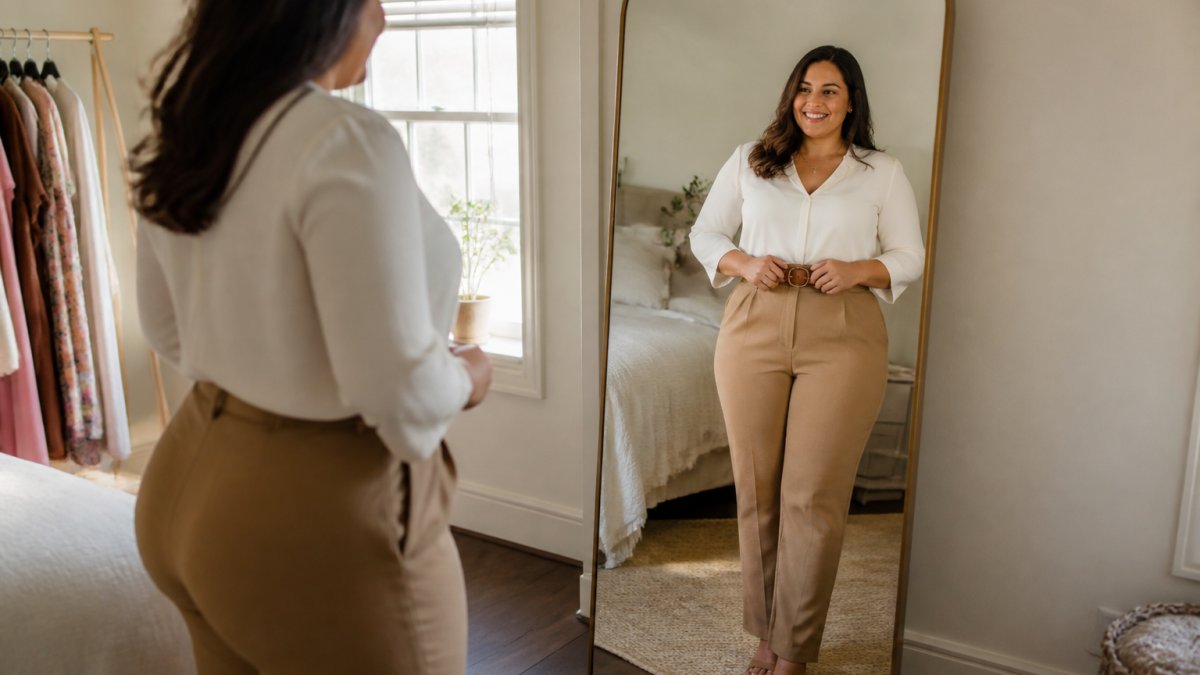
Try these pairings:
- Fitted top with wide-leg or straight pants
- Flowy blouse with high-rise, fitted jeans
- Fitted knit dress with an open cardigan
Two loose pieces erase your shape; two tight pieces fight it. One of each lets your waistline show through.
Tucking Tops to Define Your Waistline
A tucked-in top is the simplest way to define your waist, drawing the eye to the narrowest part of your middle instead of hiding your shape.
Not every top needs a full tuck. Try:
- Full tuck for high-rise pants and skirts
- Front tuck for looser tops you want to keep relaxed
- Half tuck when the fabric is thick or stiff
Our plus check peasant blouse works well with a front tuck, since the puff sleeves balance the looser body of the top.

Using Belts to Create Shape Without Squeezing
A belt should sit at your natural waist, not cinch it. Choose a width that matches your frame and skip anything that digs in when you sit.
- Wide belts suit long torsos and structured dresses
- Thin belts suit short torsos and flowy fabrics
- Match the belt tone to your shoes for a longer line
The goal is a gentle waistline, not a corset. If you can see the fabric bunching above and below the belt, it is too tight.
The Best Pants for a Curvy Figure: Waistbands, Rises, and Fabrics
The best pants for a curvy figure share three things: a contoured waistband, the right rise, and a fabric with real stretch and recovery. Get those right and you skip the gap-in-the-back problem entirely.
Read the Waistband Before You Read the Size
A contoured waistband curves higher in the back than the front, following the natural dip at your lower back instead of cutting straight across it. A straight waistband sits level all the way around, which is why it gaps when your hip-to-waist difference is more than a few inches.
Check three things on the hanger:
- Back rise vs. front rise. Lay the pants flat and compare. A back rise roughly 1 to 2 inches longer than the front rise is a good sign for a curvy seat.
- Waistband height. A 1.5- to 2-inch band holds its shape better than a thin 1-inch band that rolls when you sit.
- Stretch direction. Pull the waistband side to side, then up and down. If it only stretches sideways, it will not give over your hips when you bend.
High-Rise vs. Mid-Rise: Which Waistline Works for Your Shape
High-rise and mid-rise both work, but suit different proportions. High-rise sits at or above your natural waist and holds a curvy middle; mid-rise sits below the belly button and can work on a short torso.
| Rise | Where It Sits | Best For | Watch Out For |
|---|---|---|---|
| High-rise | At or above the natural waist | Curvy hips, long torsos | Can feel snug after meals |
| Mid-rise | Just below the belly button | Short torsos, straighter shapes | Gaps at the back waist |
If you are unsure, start high-rise. It stays put when you sit, bend, and move. To confirm the rise is right, sit down in the fitting room and check whether the back waistband lifts away from your spine.
Fabric: Stretch, Recovery, and Weight
Stretch gets the attention, but recovery matters just as much, it is how well a fabric springs back after you wear it. High stretch with poor recovery bags out at the knees and seat by mid-afternoon.
A practical way to judge it: hold a handful of the fabric, squeeze, and release. If it stays wrinkled and stretched, it will not hold its shape through a workday.
Common blends and what they do:
- Cotton with 1 to 3 percent elastane or spandex gives gentle give without losing structure.
- Cotton-polyester blends resist wrinkling and hold a crease, but feel stiffer.
- Ponte and double-knit fabrics have weight and recovery, so they smooth rather than cling.
Measure the Garment, Not Just Yourself
Size charts tell you what a brand thinks a size means; garment measurements tell you what the pants will actually do. Many retailers list a flat-lay waist and hip measurement.
Our Boyfriend Jeans are built on this idea. The high waist sits where it should, the slim straight leg keeps the line clean, and the cotton blend has just enough give.

Dresses for Curvy Body Types: Hemlines, Fabrics, and Silhouettes
Dresses for curvy body types work best when the fabric skims rather than clings.
Hemlines matter too. A midi ending at the narrowest part of your calf gives the longest, cleanest line; a hem at the widest part can cut your leg short.
Fabric choices to look for:
- Linen and cotton blends that hold a shape without clinging
- Ponte knits with real weight and recovery
- Silk and satin in fluid cuts, not stiff ones
Our scallop crop pants follow the same rule in a different shape: a heavy ponte fabric with a high rise, so the fit stays smooth all day.
Curvy Wardrobe Essentials That Mix and Match
A small set of pieces that all work together beats a closet full of one-off buys. Build your base, then add color and print.
Start with these curvy wardrobe essentials:
- One dark, high-rise straight-leg pant
- One fitted knit top in a solid tone
- One flowy blouse for contrast
Our Rachel ribbed cardigan layers over a fitted top without adding bulk, and the blue checkered top gives you a print to pair with plain bottoms.

Fit Troubleshooting: When to Tailor and What to Avoid
Most fit problems fall into a handful of patterns, each with a fix cheaper and faster than returning the garment. Here is how to diagnose the common ones and decide whether a tailor can help.
The Waistband Gaps at the Back
This is the classic curvy fit issue: pants fit your hips and thighs but stand away from your lower back. It happens when the hip-to-waist difference is larger than the pattern allows.
Fixes, in order of cost:
- A tailor takes in the back waistband. Removing 1 to 2 inches from the center-back seam is a routine alteration and usually preserves the pockets and fly.
- Add a hidden elastic or button tab. Some tailors install a small elastic insert at the back waist so the band flexes when you sit.
- Size down and let the hips out. Only works if the fabric has a seam allowance to spare, which most ready-to-wear pants do not.
Skip the fix if the gap is more than about 3 inches. At that point the rise and seat are wrong for your shape, and no waistband adjustment will fix the drape.
Thighs Feel Tight While the Waist Fits
When the waist fits but the thighs pull, the cut is too slim through the leg for your proportions. Tailoring cannot add width without a seam allowance, so this is usually a cut problem, not a size problem.
What to try instead:
- Straight or slim-straight legs rather than skinny or tapered cuts.
- A fabric with more stretch so the leg gives as you move.
- A higher rise so the widest part of the thigh sits lower on the leg, where the cut is roomier.
The Fabric Pulls Across the Hips or Bust
Horizontal creases radiating from a seam mean the garment is straining. On pants, pulling across the front hip usually means the rise is too short; on tops and dresses, pulling across the bust means the dart or size is too small.
A tailor can sometimes let out a side seam or move a dart, but only if the garment has a seam allowance. Check the inside seam before you buy, if there is no extra fabric, plan to size up instead.
Hems and Length
Hem length changes the whole line of an outfit. A midi ending at the narrowest part of your calf reads longer and cleaner; a hem at the widest part cuts your leg short.
For pants, check the break: the point where the hem meets your shoe. A slight break is classic; a heavy pool of fabric at the ankle shortens your line.
When Tailoring Is Worth It
Tailoring pays off when the garment already fits your widest measurement and only needs edge adjustments. It is worth the cost for:
- A waistband taken in on pants that fit your hips
- A hem shortened on a skirt or dress you love
- Straps adjusted on a top that fits your bust
Skip tailoring when the garment is too small across the hips, when a seam is already strained, or when the fabric is so stretchy that it will not hold a new seam. In those cases, the money is better spent on a different size or cut.
Frequently Asked Questions
What should I look for in curvy fit clothing?
Look for garments designed with extra room through the hips and thighs, a contoured waistband that prevents gaping, and fabric with enough stretch to move with you. Check that seams sit flat and don't pull across the bust or hips. A good curvy fit should skim your curves, not cling or bag. Prioritize pieces like high-rise pants and wrap-style tops that follow your silhouette.
What types of pants work well for a curvy figure?
High-rise and mid-rise styles with a contoured waistband work best for a curvy figure. Look for slim-straight or bootcut legs that balance wider hips. Fabrics with 1 to 3 percent spandex, like the Boyfriend Jeans in cotton-poly-spandex, allow movement without losing shape. Avoid low-rise cuts that create muffin tops and stiff fabrics that dig in at the waist.
How can I build a versatile curvy wardrobe essentials collection?
Start with a few core pieces: dark-wash jeans with a high rise, a structured blazer, a wrap top, and a midi skirt in a solid color. Add a cardigan like the Rachel ribbed cardigan for layering. Choose two or three neutrals and one accent color so everything mixes. Test each new piece against at least three existing items before buying to avoid orphan garments.
How should I choose dresses for curvy body types?
Choose dresses that define your waist, such as wrap, fit-and-flare, or belted styles. A hemline that falls just below the knee or at mid-calf elongates your frame. Fabrics with a bit of stretch, like ponte or jersey, drape smoothly over curves. Avoid shapeless shifts that hide your waist entirely. A V-neck or scoop neckline draws the eye upward and balances fuller hips.
Finding clothes that fit your curves should not feel like a compromise. At Jones & Ivy Collections, Inc, we build our curvy and plus-size pieces around real proportions, with high-rise denim, ponte pants, and layered tops designed to move with you. Shop our curvy collection and build a wardrobe that fits from the first wear.