
Last Updated: October 23, 2026
Quick Summary
The best sustainable fabrics for a long lasting wardrobe are hemp, linen, and wool, because their long, strong fibers resist abrasion and hold shape through repeated washing. Hemp leads on abrasion resistance, linen gains strength when wet, and long-staple wool holds shape for decades in coats and suiting. Match the fiber to the garment's job rather than chasing a single winner.
- Hemp often lasts 5 to 10+ years in mid-weight weaves and softens with washing instead of breaking down.
- Linen gains strength when wet, so cool-water washing and line drying preserve the fiber and prevent shrinkage.
- Long-staple wool resists pilling and holds shape, lasting decades in coats and suiting with simple airing.
- Cost per wear divides purchase price by realistic wears, so a $69.00 linen suit can beat a $30.00 fast-fashion dress.
- Look for GOTS, OEKO-TEX Standard 100, Responsible Wool Standard, or Zque certification to verify environmental claims.
Table of Contents
- Why Sustainable Fabrics Belong in a Long Lasting Wardrobe
- Sustainable Fabric Comparison: Durability, Care, and Cost
- Durable Natural Fabrics for Clothing: Hemp, Linen, and Wool
- Cotton, Organic Cotton, and Silk: What the Labels Don't Tell You
- How to Choose Quality Clothing Fabric Before You Buy
- Best Fabrics for Everyday Wear: Matching Fiber to Real Life
- Blends, Finishes, and Microfiber Shedding: The Trade-Offs Nobody Mentions
- Conclusion
- Frequently Asked Questions
Why Sustainable Fabrics Belong in a Long Lasting Wardrobe
Sustainable fabrics are textiles made from fibers that reduce environmental harm across production, use, and disposal, and the best ones for a long lasting wardrobe are also the toughest.
Here is the uncomfortable truth most shopping guides skip: a garment made from the "greenest" fiber on earth still ends up in a landfill if it pills, stretches, or tears within a year.
Below, we break down which fibers earn their place, how to spot quality construction, and where the trade-offs hide.
Sustainable Fabric Comparison: Durability, Care, and Cost
No single fiber wins on every measure. Hemp and linen lead on abrasion resistance, wool wins on insulation and odor control, and silk and cotton trade durability for drape and comfort.
Most fiber comparisons stop at adjectives. A more useful approach is to score each fiber against the criteria that predict whether a garment survives years of wear: abrasion resistance, tensile strength, pilling, shape retention, colorfastness, and repairability.
How the Fibers Stack Up Side by Side
| Fiber | Abrasion resistance | Pilling tendency | Shape retention | Repairability | Care level | Breathability | Typical garment lifespan with regular wear | Best for |
|---|---|---|---|---|---|---|---|---|
| Hemp | Very high | Low | High | High, strong fibers hold patches and darns | Easy; softens with washing | High | Long; often 5-10+ years in mid-weight weaves | Pants, jackets, workwear |
| Linen | High; stronger wet than dry | Low to moderate | Moderate; creases and relaxes | High | Medium; wrinkles easily | Very high | Long in structured weaves; shorter in lightweight slubs | Summer dresses, suiting |
| Wool | High in long-staple, tightly spun yarns | Low when long-staple; high when short-staple | Very high | High, reweaving and darning are practical | Low; airs clean | Medium to high | Long; decades in coats and suiting | Sweaters, coats, suiting |
| Organic cotton | Medium | Moderate to high in loose knits | Moderate | Moderate | Easy | Medium | Medium; 2-5 years in everyday knits | Everyday tops, basics |
| Silk | Medium; delicate when wet | Low | Moderate | Low to moderate | High; hand wash | Medium | Medium; best as occasion wear | Blouses, occasion wear |
| Recycled polyester | High | Low to moderate | High | Low | Easy | Low to medium | Long physically, but sheds microfibers | Outerwear, activewear |
A common mistake is reading this table as a scorecard. A linen blouse that wrinkles in ten minutes is still a better buy than a polyester one that survives a decade of washes but sheds microfibers the whole time. Match the fiber to the garment's job.
What the Durability Columns Actually Mean
Abrasion resistance is the fiber's ability to withstand rubbing at cuffs, knees, elbows, and seat seams.
Pilling is not the same as wearing out, a pill is a small ball of tangled fiber ends a fabric shaver can remove.
Shape retention matters most in knits and tailored pieces. Wool and tightly spun cottons hold their shape through repeated washing; loose cotton jersey and silk relax and stretch.
Cost per Wear Beats Sticker Price
Cost per wear is the purchase price divided by the number of times you realistically wear the garment. A $69.00 linen suit worn twice a week for three summers costs far less per wear than a $30.00 fast-fashion dress worn three times.
Care cost belongs in the same calculation. Wool that airs clean between wears needs less washing than cotton knits, and line-dried linen avoids the energy and shrinkage of machine drying.
Durable Natural Fabrics for Clothing: Hemp, Linen, and Wool
Durable natural fabrics for clothing are plant and animal fibers with long staple lengths and tight weave structures, which resist abrasion and hold their shape through repeated washing. Hemp, linen, and wool top that list for everyday wear.
Hemp: The Abrasion-Resistant Workhorse
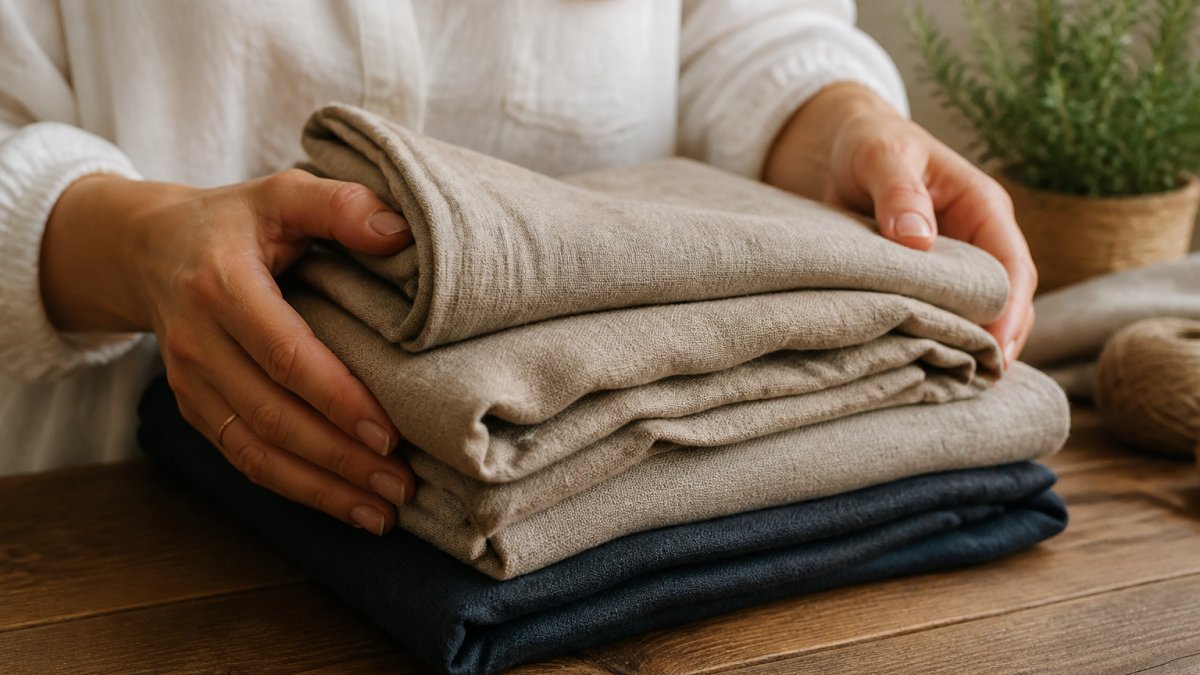
Hemp fibers are long and strong, so the fabric resists wear at cuffs, knees, and elbows better than most cottons, and it softens with every wash instead of breaking down. The catch: early wear can feel stiff and creases readily. Look for a mid-weight weave if you want drape from day one.
Linen: Stronger Wet Than Dry
Linen is the rare fiber that gains strength when wet, so laundering does not weaken it the way it does cotton. That makes linen one of the best fabrics for everyday wear in warm weather. Our Linen Jumper Suit in Taupe at $69.00 leans on exactly that quality, and it comes in Navy as well.

Cotton, Organic Cotton, and Silk: What the Labels Don't Tell You
Organic cotton is grown without synthetic pesticides, while conventional cotton relies on them, but both fibers behave the same in the wash.
Silk is the outlier: it drapes beautifully and regulates temperature well, but it loses strength when wet and hates direct sunlight.
The USDA National Organic Program sets the standards behind the organic label, so a verified certification is worth checking.
How to Choose Quality Clothing Fabric Before You Buy
How to choose quality clothing fabric comes down to three checks: fiber content, fabric weight, and construction details. Run these before you look at the price tag.
- Check the fiber content tag, not the front label
- Pinch the fabric: does it feel substantial or thin?
- Hold it to light: can you see through it?
That checklist catches obvious problems, but not whether a garment will last five years or one. The deeper signals are in the weave, the yarn, the stitching, and the paperwork behind the fiber claims.
Read the Weave, Not Just the Fiber
A tight weave outlasts a loose one in the same fiber every time. Turn the garment inside out: French seams and bound edges signal a maker who expects the piece to last.
Weave structure determines how a fabric behaves under friction. Plain weave, the over-under pattern in many shirting and linen fabrics, is stable but can fray at cut edges if the seam finish is poor.
In knits, gauge and stitch density matter more than the fiber label.
Yarn Quality and Fabric Weight
Staple length is the single best predictor of how a natural fiber will age. Long-staple cotton, wool, and linen produce smoother, stronger yarns that pill less and hold color better than short-staple versions.
Fabric weight, in ounces per square yard or grams per square meter, tells you how much material you are getting. A mid-weight woven, roughly 6 to 10 ounces per square yard for cotton and linen, balances drape and durability for everyday garments.
Stitching, Seam Finishes, and Hardware
Stitch density is a quick quality signal. Tight, even stitches, roughly 10 to 12 per inch on a standard seam, distribute stress better than long, loose ones. Look for backstitching at pocket openings, fly fronts, and armholes.
Hardware should match the load it bears. Metal zippers and reinforced buttonholes outlast plastic on outerwear, denim, and bags. On lightweight garments plastic can be appropriate, but check that buttons are attached with a shank or reinforced thread.
Verify Certifications and Environmental Claims
A fiber can be sustainable on the farm and still be processed, dyed, and finished in ways that undercut the claim. Certifications are the practical way to check.
The Global Organic Textile Standard (GOTS) goes further than farm-level organic, covering processing, dyeing, and social criteria across the supply chain.
Be skeptical of vague terms. "Eco-friendly," "green," and "natural" have no legal definition in textile marketing.
Best Fabrics for Everyday Wear: Matching Fiber to Real Life
The best fabrics for everyday wear are the ones that fit your actual routine. A wool blazer that needs dry cleaning will sit unworn if you commute by bike.
For office days, a Plaid Button Blouse at $48.00 in a cotton blend moves from desk to dinner without fuss. For weekends, the Round Neck Knit Top at $48.00 offers breathable comfort with enough structure to look polished.


Our Cream Floral Top at $48.00 shows how a simple cotton piece can anchor a small, cohesive wardrobe when the color palette is planned.
Blends, Finishes, and Microfiber Shedding: The Trade-Offs Nobody Mentions
Fiber blends are not automatically a compromise. A small percentage of elastane can extend a garment's life by helping it hold shape. The problem starts with high synthetic content, which sheds microfibers in the wash.
Microfiber shedding is the release of tiny plastic fibers from synthetic textiles during laundering, and those fibers pass through wastewater filters into waterways. Anti-wrinkle coatings and stain repellents also wear off over time.
Conclusion
Building a wardrobe that lasts takes more than picking the right fiber. It takes honest construction, sensible care, and pieces that actually fit your life. That is the standard we hold at Jones & Ivy Collections, Inc, where our curated collection spans Missy, Junior, Petite, Curvy, and maternity styles designed to move with you. Browse our contemporary apparel and start building a wardrobe you will still be wearing in five years.
Frequently Asked Questions
Which sustainable fabrics are the most durable?
Hemp and linen lead on abrasion resistance, largely because their long staple fibers hold together under repeated wear. Wool follows closely, especially in mid-weight weaves, since its crimped structure resists creasing and pilling better than flat cotton. Organic cotton is durable but softer and thinner in most everyday weights, so it wears faster at stress points like cuffs and elbows. Silk is strong for its weight but sensitive to sunlight and perspiration. A dense weave in any of these fibers will outlast a loose one, so check construction as carefully as fiber content.
Are natural fabrics always more sustainable than synthetic fibers?
No. A sustainable fabric comparison has to account for water use, chemical processing, dyeing, and how long the garment actually lasts. Conventional cotton is water-intensive, while recycled polyester diverts plastic waste but still sheds microfibers in the wash. Wool and hemp can be grown with relatively low inputs but vary widely by farm. The honest answer is that fiber type sets the starting point, and construction, care, and lifespan decide the rest. A well-made blend worn for a decade usually beats a poorly made natural piece worn twice.
How can you tell whether a fabric is durable before you buy?
Hold it up to the light and check density. Tight weaves and knits resist pilling and abrasion better than loose ones. Rub a small section between your fingers to see whether fibers shed immediately. Look at seams, hems, and buttonholes, since these fail before the fabric does. Check the label for fiber blends, because a small percentage of elastane adds stretch but can shorten lifespan. Finally, ask how the garment should be laundered. Anything requiring dry cleaning only adds cost across the years you own it.
What fabrics last the longest in everyday clothing?
For daily rotation, mid-weight linen, hemp blends, and wool in tighter weaves hold up best. Linen gets stronger when wet, so it survives laundering well, and it softens rather than thinning out. Hemp resists abrasion and holds shape through repeated washing. Wool regulates temperature and resists odor, which means fewer wash cycles and less wear and tear. For pieces that need stretch, a blend with a small amount of elastane works, but keep the natural fiber content above 90 percent so the garment keeps its structure.
How should you care for sustainable fabrics so they last longer?
Wash less often and in cold water. Line dry whenever possible, since heat breaks down fibers faster than anything else in your routine. Use a mesh laundry bag for knits to reduce friction, and skip fabric softener because it coats fibers and reduces breathability. Store wool folded rather than hung to avoid shoulder stretch. Repair small holes and loose buttons early, since a five-minute fix extends a garment's life by years. These habits matter more than the fiber itself for garment longevity.
