
Table of Contents
- The 2026 Jewelry Mood: Quiet Luxury Meets Bold Personality
- Everyday Jewelry Trends 2026: Pieces You'll Actually Wear
- Spring 2026 Jewelry Trends: Fresh Shapes and Textures
- Statement Jewelry Trends 2026: Bold Pendants and Sculptural Cuffs
- How to Layer Jewelry Without the Tangled Mess
- Personalized and Birthstone Jewelry: The 2026 Comeback
- Materials, Care, and Budget: Making Trends Last
- Frequently Asked Questions
Last Updated: October 18, 2026
The 2026 Jewelry Mood: Quiet Luxury Meets Bold Personality
Contemporary jewelry trends for the year 2026 come down to one idea: buy fewer pieces, but make each one say something.
That tension, restraint on one hand and self-expression on the other, defines the year. The Gemological Institute of America's guide to jewelry materials is a useful reference if you want to understand what you're buying before you spend.
Here's what most trend roundups get wrong: they list pieces without telling you how to wear them together. We'll fix that below, covering everyday pieces, statement styles, layering, personalization, and how to spend wisely.
Everyday Jewelry Trends 2026: Pieces You'll Actually Wear
Everyday jewelry trends for 2026 favor small, comfortable pieces you can leave on all week. The small hoop leads the pack, followed by huggies and clean studs.
Huggies, Studs, and the Return of the Small Hoop
Huggie earrings sit close to the lobe, so they rarely catch on hair or clothing. That practicality explains their staying power. Our Chain huggie earrings pair a gold chain detail with pave bar studs for $27.00, a good example of a piece that reads polished without shouting.

Studs remain the safest first purchase. If you want a set that works for gifting or a younger wearer, the Heart Necklace & Hoop Earrings in 925 sterling silver with pink CZ covers both in one box for $30.00.
Spring 2026 Jewelry Trends: Fresh Shapes and Textures
Spring 2026 jewelry trends lean toward fluid shapes, soft geometry, and textural finishes. Think curved bars, rounded pendants, and brushed surfaces rather than sharp angles. The shift matters because it changes what a piece looks like up close: a brushed or hammered surface scatters light instead of bouncing it, so a small piece reads more interesting than a plain polished one of the same size.
The Shapes Defining Spring
Three shape families keep appearing in 2026 assortments:
- Soft geometry. Rounded rectangles, open ovals, and curved bars replace hard-edged pendants. A single curved shape on a fine chain does the work of a larger, busier piece.
- Organic and shell-inspired forms. Shell, wave, and irregular pebble silhouettes carry over from last year, usually in warm gold tones or pearl finishes. These pair naturally with summer wardrobes and read as vacation-ready without being literal.
- Sculptural minimalism. One clean fold, twist, or loop in a cuff or ring, with no added stones. This is the bridge between the quiet-luxury everyday look and the statement pieces covered below.
Textures to Look For
Texture is the detail that separates a 2026 piece from a 2024 one. Brushed matte finishes, hammered surfaces, rope and twist detailing, and beaded or granulated edges all add visual weight without adding size.
Beaded and natural-stone bracelets fit this mood well. Our Multi loop bracelet layers natural stone beads on a 7-inch inner circle with 6 to 8 mm beads, priced at $15.97. The Heart stone bracelet in natural turquoise and white offers a similar soft feel at $18.99.

Mixed Metals and Pearls in the Same Look
Mixed metals also carry into spring. Pairing gold and silver in one look no longer reads as a mistake; it reads as intention. The reliable method is to repeat each metal at least twice, say, gold hoops with a gold ring, plus a silver chain and silver cuff, so the mix looks deliberate rather than accidental. Pearls follow the same logic: a single pearl pendant or a short pearl strand layered with a metal chain softens an otherwise all-metal stack.
How to Wear Spring Shapes by Occasion
- Workday: one soft-geometry pendant on a 16- or 18-inch chain, small hoops, and a brushed cuff. Keep the finish matte so it does not compete with office lighting.
- Weekend: layer the beaded bracelet with a thin metal bangle and add a shell-inspired pendant. Texture carries the look, so skip large stones.
- Evening: swap the everyday pendant for a sculptural piece and keep everything else small. One textured focal point is enough.
Materials and Care for Textured Pieces
Textured finishes collect residue in their grooves, so they need slightly more care than polished surfaces. Rinse beaded and stone bracelets with lukewarm water and dry them fully before storing, and keep pearls away from perfume and hairspray, which dull the nacre. Brushed and hammered metals can be wiped with a soft cloth; avoid abrasive polishes, which flatten the texture you paid for. Store textured pieces separately so they do not scratch smoother items in the same box.
Statement Jewelry Trends 2026: Bold Pendants and Sculptural Cuffs
Statement jewelry trends for 2026 move away from oversized sparkle and toward sculptural shapes with clean lines. A bold pendant on a simple chain does more work than a crowded stack.
The Rectangle bar star pendant shows the direction clearly: one geometric gold shape, no competing detail, $38.00. Cuff bangles follow the same logic, favoring a single strong curve over many thin bracelets.
Wear one statement piece per outfit. Two competing focal points cancel each other out, and that is the mistake we see most often.
How to Layer Jewelry Without the Tangled Mess
Layering works when each piece has a job. Start with a short base, add a mid-length layer, then finish with one pendant. Keep the gaps deliberate rather than random.
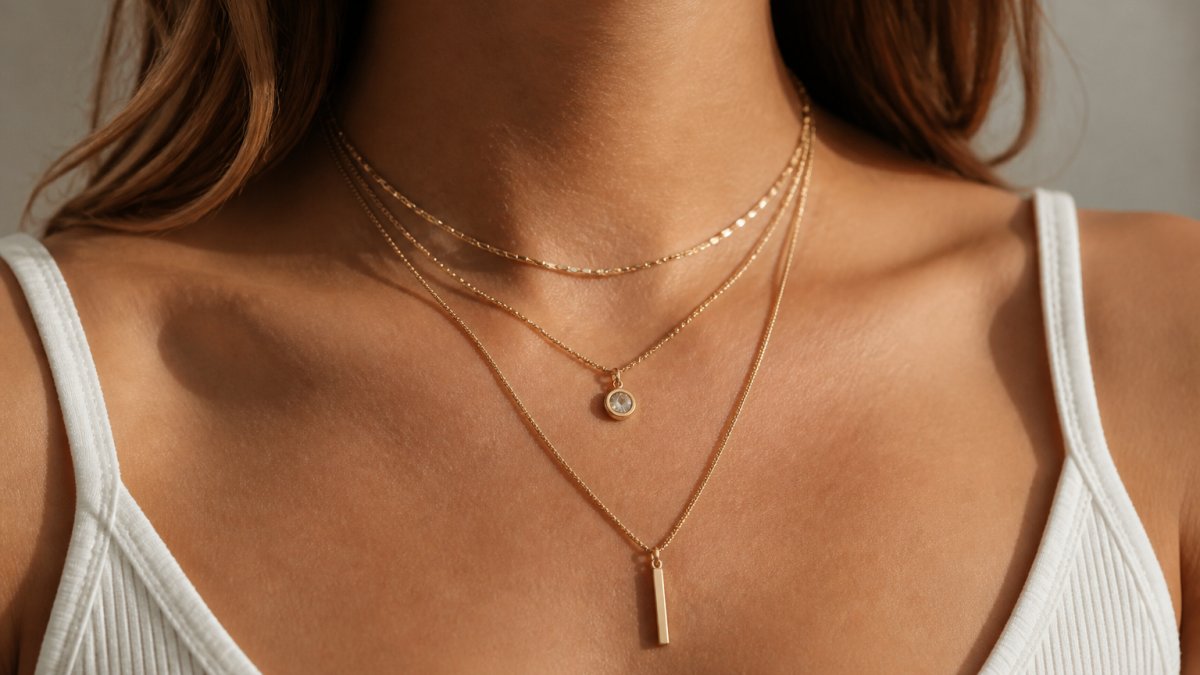
Necklace Layering: Lengths, Pendants, and Mixed Metals
Use a 2-inch gap between chain lengths so the layers stay separate. A 16-inch chain, an 18-inch chain, and a 20-inch pendant form a reliable trio.
Our I Am Enough Necklace measures 17 inches with a 2-inch extender, which makes it easy to adjust within a stack. It comes in silver or gold for $18.97.
Personalized and Birthstone Jewelry: The 2026 Comeback
Personalized pieces are the clearest answer to a wardrobe full of similar trends. Birthstone jewelry and zodiac motifs let a piece belong to one person rather than to everyone. In 2026 the category is moving in two directions at once: smaller, subtler personalization for everyday wear, and more explicit message pieces for gifting.
Birthstones: Choosing and Combining
Birthstone jewelry works best when the stone is treated as a color accent rather than the whole design. A single small birthstone in a pendant or stud reads as personal without announcing itself. When combining family or partner birthstones, keep the stones the same size and shape and limit the palette to two or three colors; more than that starts to look like a charm bracelet rather than a considered piece.
Zodiac and Symbol Motifs
Zodiac pendants, constellation designs, and initial charms follow the same rule: one symbol per piece. A zodiac pendant on a fine chain layers well with a plain chain, while a zodiac ring works as a standalone. Because these motifs are small, they suit readers who want personalization but prefer understated scale.
Morse Code and Message Jewelry
Morse code styles have grown alongside this shift. Our Morse code bracelets spell short messages in code, are adjustable, and cost $11.99, which makes them a low-risk way to test personalization. Keep messages short, a name, a date, or a single word, because longer strings become hard to read and harder to fit on an adjustable band.
For an everyday piece with meaning built in, the tassel beaded stretch bracelet comes as a two-piece set in one size for $8.50.

Personalization by Budget
- Accessible (under $20): Morse code bracelets, initial charms, and stretch beaded sets. Best for gifting, stacking, and testing whether you actually wear personalized pieces.
- Mid-range ($20 to $50): birthstone pendants, zodiac necklaces, and engraved bar pieces in sterling silver. This is where most shoppers land, because the metal holds up to daily wear.
- Investment (above $50): solid gold or fine-gemstone birthstone pieces and custom engravings. Buy these only after you know the wearer's metal preference and ring or chain size.
Sizing, Gifting, and Comfort
Personalized jewelry is hard to return, so get sizing right before you order. For bracelets, measure the wrist and add about half an inch for a comfortable fit; adjustable and stretch styles remove most of the risk. For necklaces, confirm the chain length rather than assuming, since a 16-inch chain sits very differently from an 18-inch one. If the piece is a gift, choose an adjustable style or a pendant on a chain with an extender.
How to Style Personalized Pieces
Wear one personalized piece at a time so it stays the focal point. A Morse code bracelet stacks cleanly with a metal bangle but not with another message piece. For occasions, keep personalized jewelry for everyday and sentimental settings, and switch to the statement pieces above for events where the jewelry is meant to be seen rather than read.
Materials, Care, and Budget: Making Trends Last
Trend pieces only earn their place if they survive daily wear. Check the metal before the design: sterling silver and gold-tone finishes behave very differently over a year.
Store pieces separately in a dry pouch, keep them away from perfume and chlorine, and wipe them after wear. The Federal Trade Commission's guidance on jewelry marketing claims explains how metal and gemstone descriptions should be read, which helps you judge quality before you buy.
Set a budget per category rather than per season. A practical split looks like this:
| Category | Budget Range | What to Prioritize |
|---|---|---|
| Earrings | Under $30 | Comfort and secure backs |
| Bracelets | Under $20 | Adjustability and clasp quality |
| Necklaces | $15 to $40 | Chain strength and length options |
| Statement pieces | $30 to $50 | One strong shape, clean finish |
Frequently Asked Questions
What jewelry trends are easiest to wear every day?
Small huggie earrings, a single pendant necklace, and a simple beaded bracelet are the easiest everyday pieces for 2026. Chain huggie earrings with pave bar studs, like the $27 gold pair from Jones & Ivy, work with almost any outfit. Keep the metal tone consistent across your daily pieces so they layer without clashing. The goal is a small, repeatable set you can put on without thinking.
Are statement earrings still in style for 2026?
Yes, but the shape has changed. Oversized hoops and heavy chandeliers are giving way to sculptural cuffs, soft geometric drops, and single statement pieces worn on one side. The 2026 approach is one bold element per look, not a full set. Pair a large cuff bangle or a bold pendant with small studs so the statement piece stands out instead of competing.
What is the jewelry trend for spring 2026?
Spring 2026 leans into fluid shapes, shell and pearl motifs, and mixed metals. Soft geometry, irregular freshwater pearls, and gold-and-silver combinations appear across necklaces and bracelets. Textural finishes like hammered or brushed metal also show up. For a low-commitment start, try a natural stone beaded bracelet or a pearl accent layered with a thin chain.
How do I layer jewelry without it looking messy?
Start with one anchor piece, usually a 16 to 18 inch chain, then add a second chain two inches longer and a third two inches longer again. Mix one fine chain with one textured or beaded piece so the layers read as separate. Keep pendants small and spaced out. For bracelets, stack two or three with different bead sizes and stop there so your wrist does not look cluttered.
The challenge with any trend forecast is separating what lasts from what fades by spring. We build our jewelry collection around pieces that layer together and hold up to daily wear, across Missy, Junior, Petite, Curvy, and maternity wardrobes. Explore the earrings, necklaces, and bracelets at Jones & Ivy Collections, Inc and build a stack that sounds like you.