
Table of Contents
- Start With a Focal Point and Visual Balance
- Shelf Styling Tips That Actually Work
- How to Layer Home Accessories Front to Back
- Coffee Table Decor Ideas for Every Style
- Mixing Textures, Fabrics, and Natural Elements
- Styling Small Spaces and Using Negative Space
- Affordable and Sustainable Styling Hacks
- Conclusion: Your Home, Your Story
- Frequently Asked Questions
Last Updated: October 2, 2026
Start With a Focal Point and Visual Balance
Learning how to style home decor pieces starts with one question: what should the eye land on first? A focal point is the single item a room is built around, and every other piece supports it. At Jones & Ivy Collections, Inc, we offer home decor pieces that can serve as strong anchor pieces.
Pick your anchor before anything else. Good options include:
- A large vase or sculptural object
- A bold piece of art
- A lamp with real presence
- A mirror that reflects light
Visual balance keeps the room from feeling lopsided. If your anchor sits on the left, add lighter weight on the right.
Choosing Your Anchor Piece
Choose an anchor that matches the scale of the space. A tiny figurine on a big console table disappears. A tall lamp on a narrow shelf overwhelms it.
The basics of design principles from the Getty Museum explain how scale and proportion guide the eye. Start there.
Symmetry vs. Asymmetry
Symmetry feels calm and formal. Asymmetry feels relaxed and modern. Neither is wrong.
For symmetry, mirror items on both sides of a center point. For asymmetry, balance a heavy item with two or three lighter ones.
Shelf Styling Tips That Actually Work
Good shelf styling tips come down to three moves: vary height, group in odd numbers, and leave empty space. Shelves fail when every item sits at the same level with the same visual weight.
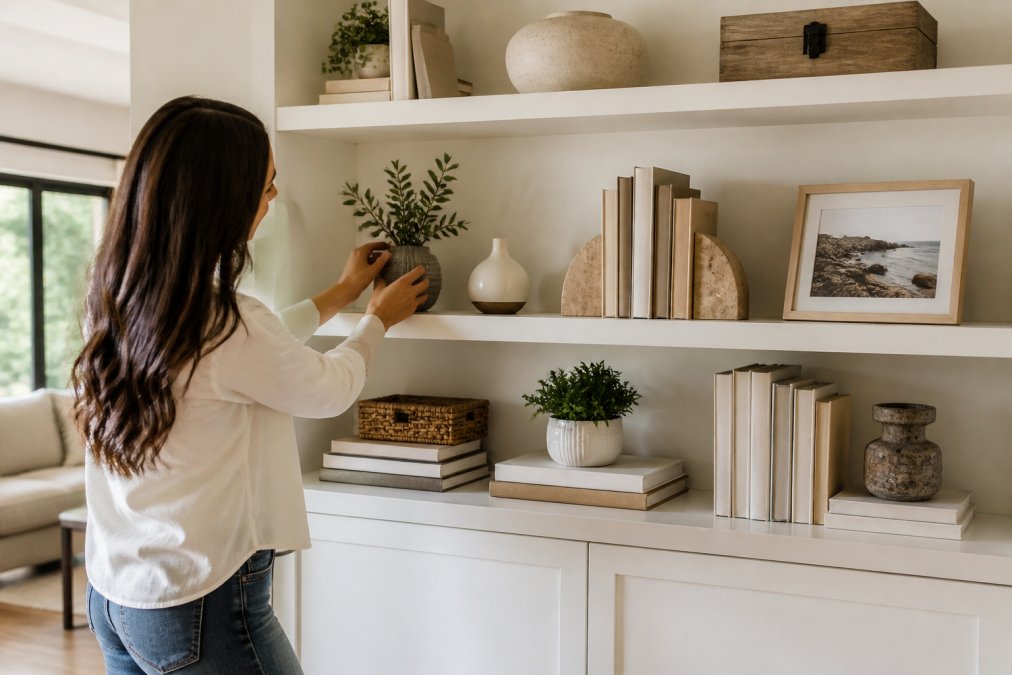
Start with the biggest item, then build around it. Add one tall piece, one medium, and one small object per shelf.
The Rule of Three and Odd Number Groupings
The Rule of Three is a styling method where items are grouped in threes (or any odd number) to create visual interest. Odd numbers feel more natural than even ones, which can look stiff and staged.
Try these groupings:
- Three vases in different heights
- A stack of books, a candle, and a small plant
- Two frames plus one sculptural object
Using Books as Risers and Pedestals
Books do double duty. Stack two or three flat, then set a small object on top. This adds height variation without buying anything new.
A common mistake is stacking too many. Keep stacks to three or fewer so they stay stable and clean.
How to Layer Home Accessories Front to Back
Layering home accessories means building depth from the back of a surface to the front. Most people line items up in a single row. That flat look is the fastest way to make a styled surface feel unfinished.
Work in three zones:
- Back: tall, large, or flat items like art or a leaning mirror
- Middle: medium pieces like lamps, vases, or stacks of books
- Front: small accents like candles, trays, or a single bloom
Each layer should partly overlap the one behind it. This creates depth and hides the bare surface underneath.
Coffee Table Decor Ideas for Every Style
The best coffee table decor ideas leave room to actually use the table. A good rule is to cover no more than one third of the surface, then leave the rest open.
- Height variation: Aim for at least a 3-inch difference between the tallest and shortest item so the eye has a path to follow.
- Odd numbers: Three or five items read as more natural than two or four.
- One living element: A single plant, bloom, or bowl of fruit adds color and softens hard surfaces.
- Scale to the table: A tiny object on a large table disappears; an oversized bowl on a small table crowds it.
If you want to go deeper on why open space matters, the psychology of space and mood from the American Psychological Association notes that visual clutter can raise stress, while open, ordered surfaces tend to read as calm. That is the practical case for leaving a third of the table bare.
Mixing Textures, Fabrics, and Natural Elements
Texture is what makes a room feel finished rather than flat. Mixing textures, fabrics, and natural elements adds contrast that photographs and the eye both pick up.
Pair smooth with rough, and shiny with matte:
- Glass and ceramic with woven baskets
- Linen and cotton with wool or jute
- Metal accents with wood and stone
Styling Small Spaces and Using Negative Space
Small-space styling rewards restraint. The goal is fewer, bigger pieces, not more small ones. A single large art piece can make a small room feel bigger than a wall of tiny frames.
Try this approach:
- Choose one focal point per surface
- Keep shelves to three to five items
- Let at least a third of each surface stay empty
Affordable and Sustainable Styling Hacks
You do not need a big budget to style a room well. The most affordable and sustainable move is to shop your own home first. Pull pieces from other rooms and see them with fresh eyes. A vase that reads as tired in the kitchen can become the anchor of a bathroom shelf.
Shop your home in three passes
- Gather: Walk every room and pull anything that is not nailed down, vases, books, bowls, frames, candles, baskets. Pile them in one spot.
- Sort: Group by color, material, and height. You will usually find you own more than you think.
- Reassign: Move at least three pieces to a room they have never lived in. Familiar objects in unfamiliar spots read as new.
Low-cost swaps that actually hold up
- Use a stack of two or three hardcover books as a riser instead of buying a pedestal. Keep stacks to three or fewer so they stay stable.
- Fill a clear jar with dried branches, seed pods, or pinecones from outside. Free, seasonal, and it adds height without weight.
- Repaint or refinish a frame you already own. A single can of matte spray paint can reset several frames at once.
- Swap lamp shades between lamps you own before buying a new lamp. The shade changes the silhouette more than the base does.
- Use a woven basket as a planter cover instead of a ceramic pot. It hides the nursery pot and adds texture at the same time.
Source secondhand with a plan
Thrift stores, estate sales, and online marketplaces are where sustainable styling gets its best pieces, but only if you shop with a list. Go in knowing the size, color, and material you need. A common pattern is to buy one strong secondhand anchor, a lamp, a mirror, a large bowl, and style around it with what you already own.
Rotate instead of replace
- Spring: Swap in lighter textiles, fresh greenery, and clear glass.
- Summer: Add natural fibers, bright accents, and outdoor elements.
- Fall: Bring in warmer tones, dried branches, and heavier throws.
- Winter: Layer in wool, candles, and darker, richer finishes.
Sustainable styling also means buying less and choosing better. A guide to reducing household waste from the EPA notes that reusing what you own cuts waste and saves money at the same time. The styling version of that principle is simple: the most sustainable piece in your home is the one you already have.
Conclusion: Your Home, Your Story
Styling a room is not about following strict rules. It is about choosing pieces that tell your story and arranging them with intention. Whether you are working with a single shelf or a whole living room, the same basics apply: start with a focal point, layer front to back, and mix textures for depth.
Frequently Asked Questions
What is the rule of three in home decor?
The rule of three is a design principle that groups items in odd numbers, typically three, to create visual balance and interest. Odd groupings feel more natural and dynamic than even numbers, which can look stiff. When you style home decor pieces, try arranging a tall object, a medium one, and a small one together. Vary their heights, textures, and shapes for a curated look that draws the eye without feeling cluttered.
How do you style a coffee table like a designer?
Start with a tray to anchor smaller items. Add a stack of two or three books, top with a small bowl or candle, and include one organic element like a vase with fresh flowers or a small plant. Vary heights: a tall vase, a medium stack of books, and a low dish. Leave some empty space so the table still functions. For coffee table decor ideas, rotate pieces seasonally to keep the look fresh.
How do you arrange home decor on shelves?
Begin by clearing the shelf and deciding on a focal point, like a piece of art or a large vase. Place it slightly off-center. Group remaining items in odd numbers, mixing books, small sculptures, and natural elements. Use books as risers to add height variation. Leave negative space between groupings so each item can breathe. Step back and adjust until the arrangement feels balanced, not crowded.
How do I choose home decor that fits my personal style?
Look at your wardrobe and the pieces you already love. If you gravitate toward clean lines and neutral colors, your home decor likely follows. For a more vibrant aesthetic, mix in bold accessories and patterns. When you style home decor pieces, choose items that spark joy and reflect your story. There is no wrong answer if the result feels like you.