
Table of Contents
- Why Choose Boutique Quality Clothing? Start With the Fabric
- How to Tell If Clothes Are Good Quality: A 6-Point Checklist
- Boutique vs. Mass-Produced Clothing: What Changes on the Rack
- Cost Per Wear: The Math That Makes Higher Prices Make Sense
- The Benefits of Boutique Shopping Beyond the Garment
- How to Choose a Boutique That Actually Fits Your Needs
- Conclusion: Quality You Can Feel, Value You Can Count
- Frequently Asked Questions
Last Updated: October 5, 2026
Why Choose Boutique Quality Clothing? Start With the Fabric
Most shoppers decide in three seconds whether a garment feels expensive. Your hands make that call before your eyes do.
Boutique quality clothing is apparel made in small batches with tighter fabric standards, closer stitching tolerances, and a narrower size run than mass-market production.
Here is the part most buying guides skip: fabric content tells you less than fabric weight and finish. A 100% polyester blouse can feel luxurious if it is woven tightly.

According to the Federal Trade Commission's textile labeling rules, every garment sold in the U.S. must carry a fiber content and country-of-origin label.
What Your Hands Can Tell You Before You Buy
Run the fabric between your thumb and fingers. If it slips without resistance, the weave is loose and it will snag.
Press a fold and release it. Quality fabric springs back. Cheap fabric holds the crease.
Hold the garment up to light. If you can see individual threads, expect pilling within a few washes.
Look at the inside, not the outside. The inside seam tells you more than any hangtag ever will.
How to Tell If Clothes Are Good Quality: A 6-Point Checklist
Good quality clothing passes six checks: fabric weight, seam finish, stitch density, pattern alignment, hardware, and label accuracy. Run every garment through this list before you buy.
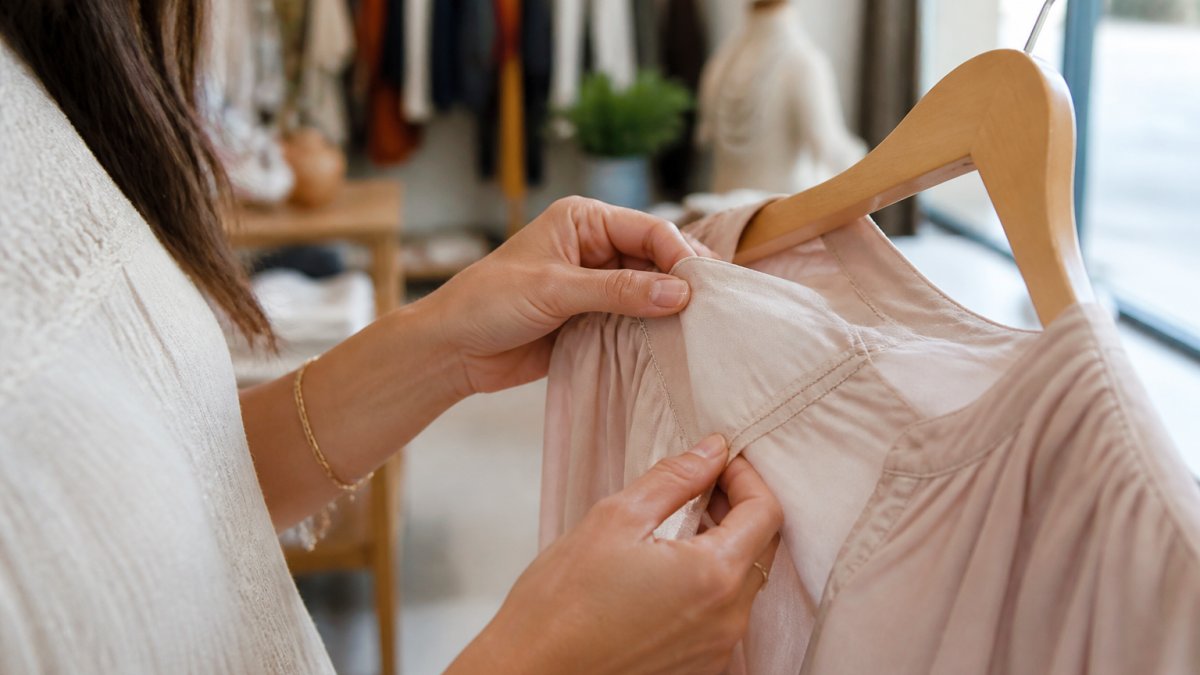
- Seams are finished, not raw. Serged or French seams mean the maker expected the garment to last.
- Stitches are tight and even. About 10 to 12 per inch is a solid benchmark.
- Prints line up at the side seams. Misaligned patterns are a shortcut signal.
- Buttons and zippers feel solid and sit flush. Cheap hardware wobbles.
Boutique vs. Mass-Produced Clothing: What Changes on the Rack
Most buying guides treat boutique and mass-market clothing as a simple good-versus-bad story. That framing is wrong, and it is why so many shoppers feel burned after paying more. The real difference is not quality versus junk. It is a different set of trade-offs in sourcing, design, fit, and price.
Here is the direct comparison the keyword is actually asking for.
Sourcing and Fabric Selection
A mass retailer buys fabric by the tens of thousands of yards. That volume gives it leverage on price, but it also locks the buyer into mills that can deliver huge, consistent runs.
A boutique buys in small lots, often a few hundred yards per style. That smaller commitment lets the buyer choose a mill with a narrower specialty, such as a tighter weave or a softer hand, without negotiating a massive minimum order.
Design and Pattern Development
Mass-market design starts with a target price and works backward. The pattern is engineered so it can be graded across a wide size run with minimal adjustment, which keeps production cheap but flattens the fit.
Boutique design usually starts with a specific body or a specific fabric and works forward. A boutique can afford to adjust the torso length on a petite cut, narrow the shoulder on a curvy cut, or add a lining where a mass pattern would skip it.
Fit and Size Grading
This is where the difference is easiest to feel. Mass production grades a pattern by scaling it up or down proportionally. A size 2X is often just a size M multiplied outward, which is why sleeves get too long and waists sit too high.
Boutique grading adjusts proportions, not just measurements. A petite blouse is cut shorter in the torso and sleeve. A curvy blouse is cut with more room through the bust and hip without adding length everywhere.
Price and Perceived Value
Mass-market pricing is built on volume. The retailer makes money on the number of units sold, so a lower price per unit is the goal.
That does not automatically make the boutique piece a better value. It makes it a different value. The mass-market piece wins on upfront price. The boutique piece wins on how many times you actually reach for it, which is the math in the next section.
What This Means for Your Rack
Neither model is inherently better. Mass production is built for speed and reach. Boutique production is built for consistency and fit. The useful question is not "which is higher quality" but "which trade-off matches how I actually wear clothes."
If you replace basics every season, mass-market makes sense. If you want a piece that fits your frame and survives multiple seasons, the boutique trade-off usually pays off.
Cost Per Wear: The Math That Makes Higher Prices Make Sense
Cost per wear is the purchase price divided by the number of times you actually wear the item.
A $48 top worn 40 times costs $1.20 per wear. A $20 top worn four times and then pushed to the back of the closet costs $5.00 per wear.
Here is how the math plays out across a year:
| Garment Type | Price | Wears Per Year | Cost Per Wear |
|---|---|---|---|
| Boutique blouse | $48 | 40 | $1.20 |
| Fast-fashion top | $20 | 4 | $5.00 |
| Boutique blouse (year 2) | $0 | 30 | $0.00 |
| Fast-fashion top (replaced) | $20 | 4 | $5.00 |
The second-year row is the point. A garment that survives a second season keeps paying you back. A garment that pills or tears after two washes never does.
The Three Levers That Move the Denominator
Most shoppers focus on the numerator, the price. The real leverage is in the denominator, the number of wears. Three things control it.
Durability. A tightly woven fabric with finished seams resists pilling, snagging, and seam failure. A loosely knit fabric with raw edges does not.
Repairability. A garment with a generous seam allowance and standard buttons can be repaired.
A Worked Example
Say you buy a $48 boutique blouse and wear it once a week for a 40-week working year. That is 40 wears, or $1.20 per wear.
Now compare a $20 fast-fashion top worn four times before it pills. That is $5.00 per wear, and it never improves because the garment does not survive to year two. You replace it, and the cycle restarts.
What Cost Per Wear Does Not Tell You
Cost per wear is a tool, not a verdict. It does not capture how a garment makes you feel, whether it fits your lifestyle, or whether you actually enjoy wearing it. A cheap piece you love can beat an expensive piece you avoid.
The number is most useful when you compare two garments you would genuinely wear. If you would not reach for either one, neither belongs in your closet.
The Benefits of Boutique Shopping Beyond the Garment
The benefits of boutique shopping extend past the fabric. You get fit support, smaller stock runs, and a curated selection that mixes together.
- Fit guidance. A boutique can tell you how a specific style runs, not just what size to order.
- Curated stock. Fewer pieces per rack means each one was chosen on purpose.
- Real reviews. You can often see how a garment looked on someone with your shape.
- Repair and care advice. Staff who know the fabric can tell you how to wash it.
Secondhand and resale shoppers benefit too. Quality garments hold up well enough to resell, which is why the EPA's data on textile waste keeps showing clothing as a major share of landfill volume. Buying fewer, better pieces cuts that waste at the source.
How to Choose a Boutique That Actually Fits Your Needs
Choosing a boutique comes down to five questions: does it carry your size range, does it show real customer photos, does it explain its fabric, does it accept returns, and does its collection mix together?
Ask before you buy:
- What sizes does this style actually come in? A boutique that lists Petite, Curvy, and maternity separately is grading patterns, not just scaling them.
- Can I see this on a real customer? Reviews with photos beat studio shots every time.
- What is the fabric content and care? If the listing is vague, that is your answer.
- What is the return window? A confident boutique stands behind its fit.
- Will this work with what I own? A curated collection should mix, not compete.
A common mistake is buying one statement piece that matches nothing else in your closet. Start with a versatile base and build out.
Our Abstract Flower Print Woven Blouse at $48.00 is made in the USA and pairs with denim, tailored trousers, or a pencil skirt. The Plus Check Peasant Blouse at $59.00 comes in 1X through 3X with a quarter button-up front and puff sleeves, cut for a curvy frame rather than scaled up from a straight size.


For a maternity-friendly option, the Blouse at $38.50 has balloon sleeves and a flowy multi-color cut that works through every trimester. The Plaid Floral Top at $48.00 is also made in the USA with 3/4 sleeves for a polished office look.
Conclusion: Quality You Can Feel, Value You Can Count
The hardest part of building a wardrobe is trusting that a higher price will actually pay off. Most shoppers have been burned by a boutique that charged more and delivered less.
At Jones & Ivy Collections, Inc, we build our collection around that trust. Our pieces span Missy, Junior, Petite, Curvy, and maternity fits.
Add a piece you will reach for forty times this year, not four.
Frequently Asked Questions
Are boutique clothes really better quality than what I find at big retailers?
Not automatically, which is why the fabric and construction matter more than the label. Boutique quality usually shows up in heavier fabric, cleaner stitching, and consistent sizing because production runs are smaller and inspected more closely. Mass-produced clothing is often cut to a price point, so fabric is thinner and seams are finished faster. Run your hand along the inside seam and check for loose threads or puckering. If the garment feels substantial and the stitching runs straight, you are looking at the difference boutique shoppers pay for.
Is boutique clothing worth the price compared to mass-market brands?
It depends on how often you wear the piece. A $48 blouse worn twice a month for two years costs about $1 per wear. A $20 top that pills after six washes and gets donated costs more per wear than that. Boutique pieces tend to hold their shape, resist snags, and stay in rotation longer, so the price spread narrows over time. The real question is not what you pay at checkout, it is what each wear costs you.
How do I know a boutique's sizing will actually fit me, especially in petite or curvy sizes?
Ask three things before you buy: whether the boutique publishes a sizing guide with garment measurements, whether customer reviews mention fit accuracy, and whether the return policy covers fit issues. Boutiques that design for petite or curvy bodies usually adjust proportions, not just scale a pattern down or up. Look for reviews that mention true to size or note where a piece runs small. A boutique confident in its fit support will answer sizing questions directly rather than pointing you to a generic chart.
How can I build a versatile wardrobe using boutique pieces without overspending?
Start with two or three neutral staples you will wear weekly, then add one statement piece per season. Boutique collections are usually curated to work together, so a blouse, a printed top, and a structured layer can mix into a dozen outfits. Check that each new piece pairs with at least three items you already own before buying. This approach keeps your cost per wear low and prevents the closet full of random trendy items problem.