
Table of Contents
- What Fast Fashion and Slow Fashion Actually Mean
- Slow Fashion vs Fast Fashion: A Side-by-Side Comparison
- The Benefits of Slow Fashion That Go Beyond Your Closet
- Slow Fashion on a Budget: Practical, Affordable Alternatives
- How to Build a Sustainable Wardrobe You Actually Wear
- How to Make Clothes Last Longer: Care, Repair, and Resale
- Where Slow Fashion Falls Short: Honest Trade-Offs to Know
- Frequently Asked Questions
Last Updated: October 12, 2026
What Fast Fashion and Slow Fashion Actually Mean
Choosing slow fashion over fast fashion comes down to one trade: you pay more upfront for a garment built to last, or less now for one designed to be replaced. That single decision shapes your budget, your closet, and the environmental footprint of everything you wear.
The two models are not variations on a theme. They are opposite answers to the same question: how fast should clothing move from factory to landfill?
Fast Fashion: Mass Production and Trend-Driven Clothing
Fast fashion is a retail model built on speed and volume. Designs move from runway to store in weeks, production runs are enormous, and prices stay low because volume carries the margin.
The result is trend-driven clothing made to be worn for a season. Short-lived trends, synthetic fibers, and thin construction keep costs down. That low price is real, but it is subsidized by something: garment lifespan.
Slow fashion definition
Slow fashion is a design and buying philosophy that prioritizes quality over quantity, ethical production, and garments made to last for years rather than weeks. It favors natural materials like cotton and linen, smaller production runs, and transparent supply chains.
The core idea is simple: buy less, buy better. Fewer pieces, chosen carefully, worn often.
Slow Fashion vs Fast Fashion: A Side-by-Side Comparison
The comparison is not close once you look past the price tag. Fast fashion wins on upfront cost. Slow fashion wins on nearly everything else, but the wins are only meaningful if you can see the math and the boundaries behind them.
| Factor | Fast Fashion | Slow Fashion |
|---|---|---|
| Upfront cost | Low per item | Higher per item |
| Cost per wear | High over time | Low over time |
| Materials | Mostly synthetic fibers | Often cotton, linen, natural materials |
| Garment lifespan | One or two seasons | Several years |
| Production | Mass production, opaque supply chain | Smaller runs, more transparency |
| End of life | Discarded, often to landfill | Repaired, resold, or reused |
| Repairability | Often not designed for repair | Seams, buttons, and hems built to be fixed |
| Resale value | Near zero after a season | Retains value if cared for |
Upfront Cost vs Long-Term Value and Cost Per Wear
A $20 top worn five times costs $4.00 per wear. A $69 linen jumper worn fifty times costs about $1.38 per wear.

That math gets stronger when you add repair.
Run the same math across a year. Five $20 tops replaced twice a year is $200 for ten garments that each see limited use.
This is where the "slow fashion is only for wealthy shoppers" argument falls apart. The upfront cost is higher.
Environmental Impact: Carbon Emissions, Water Use, and Textile Waste
Three impact areas matter most, and each has a different mechanism:
- Carbon emissions. Production and shipping dominate for most garments, but the use phase, especially hot-water washing and machine drying, can rival production over a garment's life. A piece worn fifty times and air-dried carries a very different footprint than the same piece washed hot after every wear and dried on high heat.
- Water use. Growing conventional cotton is water-intensive, and dyeing and finishing add more. Fiber choice and dye method move this number more than the label on the tag does. Linen and recycled fibers typically carry a different water profile than conventional cotton or polyester.
- Textile waste. This is the most visible impact. Discarded clothing arrives at landfill in volume, much of it still wearable. Synthetic fibers do not break down quickly, so those garments persist for decades; natural fibers break down faster but still occupy landfill space and release methane as they decompose.
Slow fashion reduces all three by producing less and keeping each piece in use longer, but only when the garment is actually worn, repaired, and eventually resold or recycled.
A overview of textile waste and clothing disposal is a useful starting point for understanding where discarded clothing ends up and why keeping garments in circulation matters more than the fiber on the tag.
The Benefits of Slow Fashion That Go Beyond Your Closet
The benefits of slow fashion extend well past the environment. They show up in how you get dressed in the morning.
A smaller wardrobe of pieces you actually love makes decision-making faster. When everything fits and coordinates, you stop staring into a packed closet with nothing to wear.
There is also the worker side. Ethical fashion means fair labor and safer working conditions for garment workers, and transparency about where clothing is made.
Slow Fashion on a Budget: Practical, Affordable Alternatives
Cost is the number one objection to slow fashion, and it is a fair one. A full closet swap is not realistic for most people. The good news is that slow fashion on a budget is entirely possible.
Here is how to start without overspending:
- Thrift and consignment first. Secondhand clothing is the cheapest route into quality pieces.
- Buy fewer, better items. Replace one worn-out staple at a time instead of overhauling everything.
- Shop end-of-season. Quality pieces often drop in price when a colorway rotates out.
- Check resale platforms. Gently used high-quality clothing sells for a fraction of retail.
- Watch for made-in-USA and small-batch labels. They often signal shorter, more accountable supply chains.
How to Build a Sustainable Wardrobe You Actually Wear
Building a sustainable wardrobe starts with subtraction, not addition. Most people already own more than they wear.
Try this approach:
- Pull everything out and sort into keep, repair, and donate piles.
- Identify the gaps: the pieces you reach for but do not own.
- Buy only those gaps, and buy them well.
- Choose pieces that mix with what you kept.
A guide to textile waste and clothing disposal is a useful reality check on where discarded clothing ends up. The point is not guilt. It is that buying less and wearing longer is the highest-impact change most shoppers can make.
How to Make Clothes Last Longer: Care, Repair, and Resale
Making clothes last longer is the cheapest sustainability move available, and it costs almost nothing.
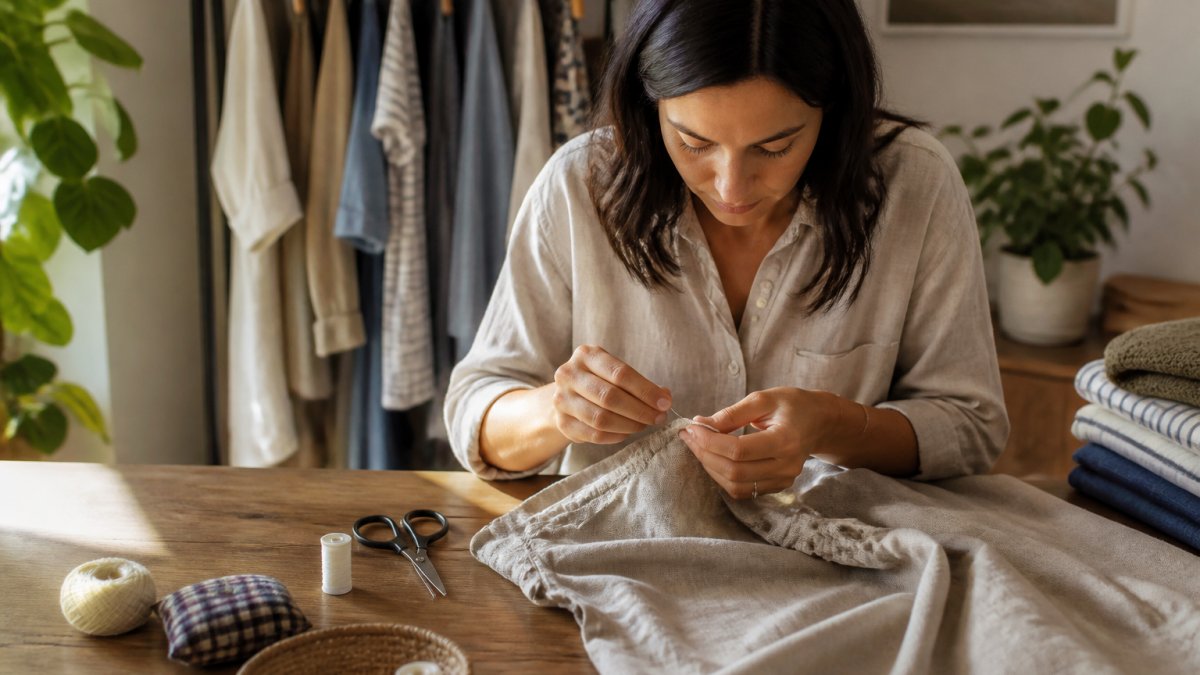
Start with clothing care. Wash less often, use cold water, and air-dry when you can.
Then learn one repair. A basic hem stitch and a button reattach cover most everyday damage. Repair extends garment lifespan more than any other habit.
When a piece is truly done, resell or donate it. Secondhand clothing keeps items in circulation and out of landfill.
Where Slow Fashion Falls Short: Honest Trade-Offs to Know
Slow fashion has real limitations, and pretending otherwise does not help anyone. The honest trade-offs:
- Higher upfront cost. The math works over years, not at checkout. A single slow-fashion piece can cost several times a fast-fashion equivalent, and the payoff depends on how often you wear it.
- Smaller selection. Fewer options, less trend-chasing, and fewer colorways. If you enjoy variety, this is a genuine constraint.
- Sizing gaps. Not every slow brand serves petite, curvy, or maternity fits well. Some run narrow through the shoulders or short through the inseam, and returns can be costly.
- Material trade-offs. Natural fibers are not automatically better. Conventional cotton is water-intensive, some "natural" dyes fade faster, and certain plant-based leathers rely on plastic binders. Fiber choice is a set of trade-offs, not a clean win.
- Greenwashing risk. "Sustainable," "eco-friendly," and "conscious" are marketing terms, not regulated certifications. A slow-fashion label alone does not guarantee anything.
That last point deserves the most attention, because it is the one shoppers can act on immediately.
How to Verify Ethical and Sustainability Claims
A practical checklist for reading any label, slow, fast, or in between:
- Look for specific certifications, not adjectives. Third-party programs such as GOTS (Global Organic Textile Standard), Fair Trade Certified, bluesign, and OEKO-TEX STANDARD 100 each verify a defined set of claims. A logo with no standard behind it is decoration.
- Check whether the supply chain is named. A brand that lists its mills, factories, or farms is easier to verify than one that says "ethically made" with no location. Named suppliers can be checked; vague ones cannot.
- Read the fiber content, not the marketing. A garment that is 95% polyester with a "sustainable" tag is still mostly polyester. Fiber percentages are on the care label and are not optional.
- Look for a published impact report or supplier list. Brands that measure and disclose tend to update these annually. A one-time "sustainability page" with no dates is a warning sign.
- Watch for vague or absolute language. "100% sustainable," "zero impact," and "planet-positive" are claims no garment can fully support. Specific, bounded claims ("this style uses 60% recycled cotton") are more credible than sweeping ones.
- Check the care and repair guidance. A brand that publishes repair instructions, spare buttons, or a resale program is signaling that it expects the garment to last. A brand that does not is signaling the opposite.
The FTC's Green Guides on environmental marketing claims explain what brands are and are not allowed to claim, which helps you read labels critically and spot the difference between a verified claim and a vibe.
What This Means in Practice
Verification takes a few minutes per brand, and it is worth doing once. Pick two or three labels you actually wear, run the checklist, and you will quickly learn which ones publish specifics and which ones rely on adjectives.
The good news is that some brands close the sizing and selection gaps. Jones & Ivy Collections, Inc carries contemporary clothing across Missy, Junior, Petites, Curvy, and maternity ranges, so slow-fashion shoppers are not stuck choosing between ethics and fit.
Frequently Asked Questions
What are the key differences between fast fashion and slow fashion?
Fast fashion relies on mass production and trend-driven clothing, pushing new styles out weekly at low upfront cost. Slow fashion focuses on quality over quantity, durable construction, natural materials like cotton and linen, and ethical production with fair labor. The trade-off is higher upfront cost but better garment lifespan, lower textile waste, and stronger long-term value through cost per wear.
Is slow fashion more expensive than fast fashion?
The sticker price is usually higher, but cost per wear often flips the math. A $69 Linen Jumper Suit worn 50 times costs about $1.38 per wear. A $20 fast fashion alternative worn five times before it pills or tears costs $4 per wear. Slow fashion on a budget is possible through secondhand clothing, resale, and buying fewer, more versatile pieces.
How can I tell if a clothing brand follows slow fashion practices?
Look for transparency about the supply chain, named factories, and materials like cotton or linen rather than vague claims. Check whether the brand explains production practices, fair labor standards, and working conditions. A brand that publishes specifics about where and how garments are made is easier to trust than one that only uses sustainability buzzwords on a landing page.
How can I make my clothes last longer?
Wash less often, in cold water, and air dry whenever possible. Repair small issues like loose buttons, hem tears, and seam splits before they grow. Store knits folded rather than hung, rotate your wardrobe instead of overwearing favorites, and use resale or donation as a final step. These habits extend garment lifespan and reduce clothing waste sent to landfill.
Slow fashion asks you to spend more thoughtfully, not more often, and that shift is harder than it sounds when cheap clothing is everywhere. Jones & Ivy Collections, Inc makes it easier with curated, versatile pieces across Missy, Junior, Petites, Curvy, and maternity fits, built for self-expression and real wear. If you are ready to buy less and buy better, start with one piece you will actually wear for years.