
Table of Contents
- Is Expensive Boutique Clothing Worth It? The Honest Answer
- Why Are Boutique Clothes So Expensive?
- How to Tell if Clothes Are Good Quality Before You Buy
- Boutique vs. Fast Fashion: What Changes When You Pay More
- Cost Per Wear Clothing: The Math That Settles the Argument
- Hidden Costs, Resale Value, and Repair
- Who Should Buy Expensive Boutique Clothing, and Who Should Not
- Frequently Asked Questions
Last Updated: October 14, 2026
Is Expensive Boutique Clothing Worth It? The Honest Answer
Is expensive boutique clothing worth it? It depends on whether the piece earns its keep over time.
Most shoppers assume price equals quality. That assumption fails more often than people expect.
A garment can cost three times as much as a similar piece and still fall apart in a year. The real test is not the label or the price tag.
Below, we walk through where your money actually goes, how to inspect quality before you buy, and the cost-per-wear math that settles the debate.
Why Are Boutique Clothes So Expensive?
Boutique clothing costs more because of smaller production runs, better materials, and higher labor standards. A boutique cannot spread costs across millions of units the way a mass retailer can. Every step, from fabric sourcing to finishing, costs more per garment.
Where the Money Actually Goes
Fabric is usually the largest single cost. Natural fibers like cotton, linen, wool, and silk cost more than synthetic blends.
Labor is the second major cost. Smaller runs mean less automation and more hands-on work. Skilled sewers and pattern makers charge more than factory line production.
Then there is the design and sampling process. A boutique typically develops fewer styles but refines each one further.
Marketing and retail space add the rest. Boutiques rarely have the buying power to negotiate deep discounts on rent, packaging, or photography.
None of this guarantees quality. The Federal Trade Commission's guidance on textile labeling requires accurate disclosure of fiber content, so you can verify what you are actually paying for.
How to Tell if Clothes Are Good Quality Before You Buy
You can judge clothing quality before buying by checking five specific details: seams, fabric weight, stitching density, lining, and hardware. None of these require special tools. A few minutes of inspection tells you more than any price tag.
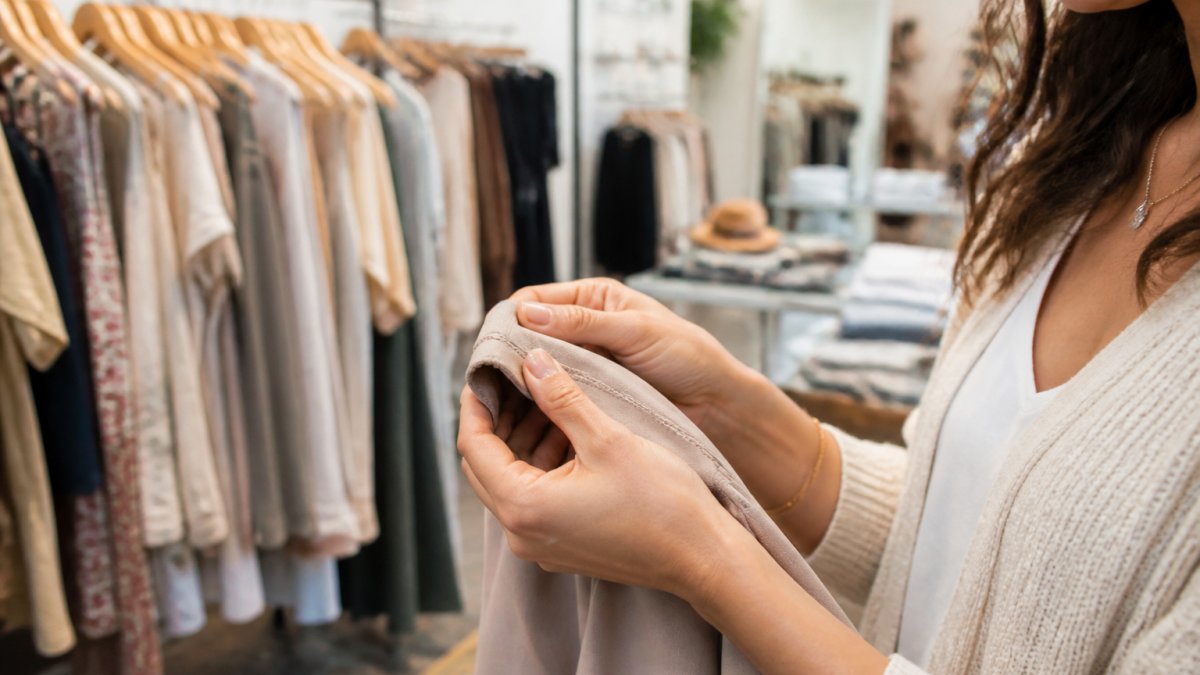
The Five-Point Quality Check
- Seams: Turn the garment inside out. Look for finished edges, not raw or fraying ones.
- Stitch density: Count stitches per inch. Denser stitching generally means stronger construction.
- Fabric weight: Hold it up to light. Thin, see-through fabric rarely lasts through repeated washing.
- Lining: Check if the lining is attached properly and made from a breathable material.
- Hardware: Zippers, buttons, and clasps should feel solid, not loose or flimsy.
A common mistake is judging quality by the outside only. The inside tells the real story.
Boutique vs. Fast Fashion: What Changes When You Pay More
Boutique and fast fashion differ most in production volume and material choice, not just price. Fast fashion relies on rapid turnover and low-cost materials. Boutiques typically produce fewer pieces with more attention to each one.
Here is how the two compare on the factors that matter most:
| Factor | Boutique Clothing | Fast Fashion |
|---|---|---|
| Production run | Small, limited | Massive, high volume |
| Fabric | Often natural fibers | Often synthetic blends |
| Construction | Finished seams, denser stitching | Rushed, minimal finishing |
| Fit consistency | More tailored sizing | Standardized, less precise |
| Longevity | Years with proper care | Often one season |
The trade-off is real. Fast fashion wins on price and variety. Boutique clothing wins on durability and fit, but only when the piece is actually well made.
That is why the quality check matters more than the label.
Cost Per Wear Clothing: The Math That Settles the Argument
Cost per wear is the purchase price plus ownership costs, divided by the number of times you actually wear the item. It is the single most useful number for deciding whether an expensive piece is worth buying, and almost no boutique-versus-fast-fashion article shows the math. Here it is.
The Formula
Cost per wear = (purchase price + alterations + care + repairs − resale value) ÷ total wears
Most shoppers stop at the purchase price. That is the mistake. A $40 top worn twice costs $20 per wear. A $200 jacket worn 80 times costs $2.50 per wear. The cheaper item lost.
Three Realistic Scenarios
These use round numbers you can swap for your own. No brand names, no invented statistics, just the arithmetic.
Scenario 1: The weekly staple. A well-made blazer at $220, altered once for $30, dry cleaned four times a year at $15 each over three years, worn twice a week (about 100 wears per year, 300 total).
- Total cost: $220 + $30 + $180 = $430
- Cost per wear: $430 ÷ 300 = $1.43
Scenario 2: The fast-fashion equivalent. A $60 blazer, no alterations, machine washed at home, worn twice a week but replaced every 10 months because the seams split and the lining pills. Over three years you buy three of them (about 300 wears total).
- Total cost: $60 × 3 = $180
- Cost per wear: $180 ÷ 300 = $0.60
On this math the cheap blazer wins, until you factor in the time spent replacing it, the fit you never quite got, and the fact that the third one may not match the first.
Scenario 3: The statement piece. A $400 occasion dress worn four times, dry cleaned twice at $20 each, then resold for $120.
- Total cost: $400 + $40 − $120 = $320
- Cost per wear: $320 ÷ 4 = $80
That is a terrible cost per wear. It is also fine, if you loved wearing it and the resale recovered part of the price.
How to Run Your Own Numbers Before You Buy
- Estimate how many times per year you will realistically wear the piece. Be honest, most people overestimate by half.
- Multiply by the years you expect it to last. A well-constructed garment with finished seams and quality fabric typically outlasts a rushed one by several seasons, but only if you care for it.
- Add estimated alterations, cleaning, and one likely repair.
- Subtract any resale value you could realistically recover.
- Divide.
If the result is lower than what you would pay per wear for a replacement, the expensive piece is the better buy. If it is higher, it is not, no matter how good it looks on the rack.
Hidden Costs, Resale Value, and Repair
The sticker price is not the full cost of ownership. Alterations, cleaning, repairs, shipping, and returns all change the real number, and so does what you can recover when you are done with the piece. This is the part most buying guides skip.
Alterations
Boutique sizing is often more tailored, but it is not custom. Expect to pay for hemming, taking in a waist, or shortening sleeves. Common alterations, a hem, a waist take-in, sleeve shortening, typically run from roughly $15 to $60 per adjustment depending on the garment and the tailor. A jacket with working buttonholes on the sleeves is harder and more expensive to shorten than one without. Ask before you buy whether the shoulders and chest fit, because those are the two alterations most tailors will not attempt economically.
Care and Cleaning
Fabric composition drives care cost. Wool, silk, and lined garments usually need dry cleaning, which runs several dollars per item per visit. Cotton, linen, and many knits can be washed at home if the care label allows. A garment that requires dry cleaning after every wear can cost more in care over a year than a washable piece costs to replace. Check the care label before the price tag.
Repairs
This is where construction quality pays off. A garment with generous seam allowances and quality fabric can be re-stitched, re-lined, or re-buttoned. Cheap construction often cannot be repaired economically, the fabric tears at the needle holes, or the seam allowance is too narrow to resew. A common pattern is that a well-made piece gets one or two repairs over its life and keeps going, while a rushed piece gets thrown out at the first failure.
Resale Value
Resale changes the math, but only for some pieces. Recognized labels with documented materials and construction tend to hold value better than unbranded fast fashion, which often resells for very little. Coats, handbags, and structured jackets resell better than trend-driven tops. Platforms that specialize in secondhand clothing make resale easier than it used to be, but the recovered amount depends on condition, demand, and how quickly you want to sell.
Shipping and Returns
Online boutique shopping adds two more line items. Shipping is straightforward, but return policies are not. Some boutiques charge restocking fees, some only offer store credit, and some require returns within a short window. Read the return terms before you order, because a piece that does not fit and cannot be returned economically is a total loss, not a bargain.
The Full-Lifecycle Rule
Before you buy, add up the realistic total: purchase price, one alteration, a year of care, one likely repair, and subtract a conservative resale estimate. If that number still beats the alternative, buy it. If it does not, the price tag was telling you something. The Environmental Protection Agency's data on textile waste is worth weighing here too, since garments that cannot be repaired or resold are the ones most likely to end up discarded.
Who Should Buy Expensive Boutique Clothing, and Who Should Not
Boutique clothing pays off for people who wear their pieces often and keep them for years.
It also works well for people who struggle with fit in standard sizing.
It does not pay off for everyone. If you chase trends and rotate your wardrobe constantly, expensive pieces rarely earn their keep.
The challenge is finding boutique pieces that actually deliver on quality and fit, not just a higher price tag.
Frequently Asked Questions
Why is boutique clothing so expensive?
Boutique clothing costs more because of smaller production runs, higher-quality fabrics, and construction that takes more time per garment. A boutique might order 200 units of a dress; a mass retailer orders 200,000. That smaller scale means higher per-unit cost for materials, labor, and design. Many boutiques also pay workers fair wages and use mills that charge more for better fabric. You are paying for the garment itself, not just the label.
Is boutique clothing better quality than clothing from a big-box store?
Not automatically. Price alone does not guarantee quality. A boutique can charge $180 for a dress with thin fabric and loose stitching. That is why you need to check construction yourself: look at seam density, fabric weight, lining, and whether patterns match at the seams. When a boutique does invest in better materials and construction, the difference shows up in how the garment holds its shape after repeated washing and wearing.
How do I calculate cost per wear for a clothing item?
Divide the purchase price by the number of times you realistically expect to wear it. A $150 blazer worn twice a week for two years works out to roughly $1.44 per wear. A $40 top worn three times costs $13.33 per wear. The formula only works if you are honest about wear frequency. Track how often you actually wear similar pieces you already own before using that number to justify a new purchase.
What should I check before buying expensive boutique clothes online?
Check the return policy first, including whether return shipping is covered and how many days you have. Read the fabric composition, not just the description. Look for customer photos rather than only studio shots. Search for reviews that mention fit on body types similar to yours. If the boutique offers sizing guidance or fit notes for petite, curvy, or maternity frames, that is a sign they have thought about proportions, not just scaled up a standard pattern.